
By Anna Brown: Owner of Union County News
Through a partnership with the School of Nursing at USC Union, Paramedics and EMTs with Union County EMS are getting experience in some serious calls that they don’t often encounter.
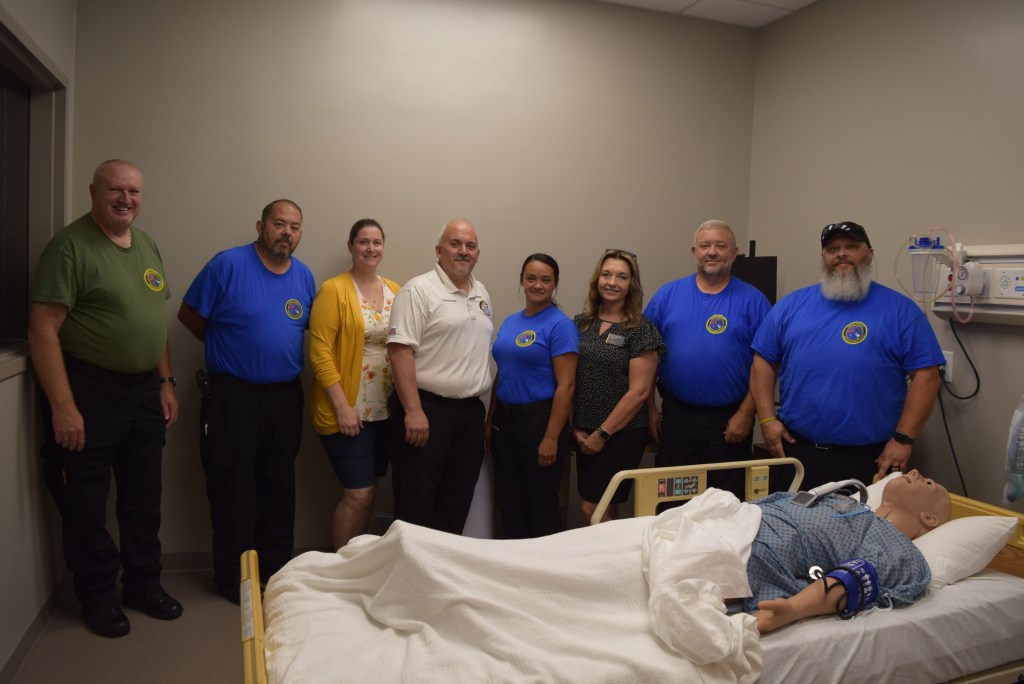
The school is allowing medics to train in their Nursing Simulations Laboratory on their high-fidelity interdisciplinary patient simulators. The patient simulators blink their eyes, have pupils that constrict when exposed to a pen light, talk, breathe, have a heartbeat, pulse, lung sounds, and other lifelike features.
Nursing Administrator Lynn Edwards said the school is glad to offer the facility to EMS for training. “We have been talking about it since we started talking about building this building,” she said.
Union County EMS Assistant Director Robert Martin said the crews are using the time in the Sim Lab to train for difficult calls. “We don’t see a lot of difficult calls; we see the same things over and over,” Martin said. “This helps our education and makes us better medics. Difficult calls would be someone having a heart attack and a stroke at the same time. Severe burn victims are difficult calls. Pregnancies – since we don’t have OB in Union anymore- can be difficult calls. We have a 30-minute ride to Spartanburg if you are in town, if you are in Carlisle it is a 45 minute ride.”
Jimmy Eubanks, a paramedic with Union County EMS who has a background that includes around 14 years in simulation, assisted with the training, created the scenarios for the crews and controlled the responses of the simulator. He and Martin watched through a two-way mirror as medics entered the scene and treated patients in different scenarios.
“Are you a doctor?” a patient simulator asked medics. “Can’t you just take me to the hospital?”
Martin said the lifelike responses are a good learning tool.
“High fidelity is nice for the students because they don’t have to have to learn on a live patient,” he said. “It is nice for us to enhance our training and to make ourselves better as medics.”
The first scenario was a patient in a structure fire that had sustained burns on more than 90 percent of his body. Medic Christina Lamb and EMT Gerald Privette arrived. They took the patient’s vital signs and began preparing him for a helicopter flight to the Augusta Burn Center.
“I don’t like needles,” the patient told Lamb and Privette.
The patient told the crew he was having trouble breathing. They gave him oxygen and began calculating the amount of fluids he would need.
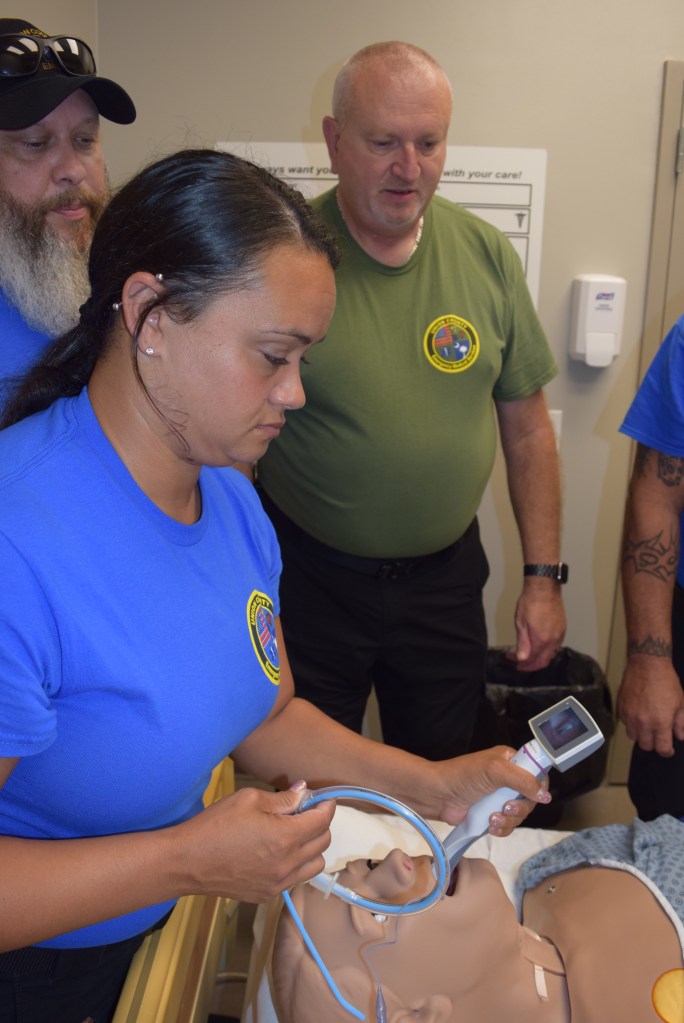
Martin, playing the role of Medic 6, who responds to back up medics on serious calls, arrived to assist Lamb and Privette. They intubated the patient using a video laryngoscope. This device has a camera near the tip of the blade to improve viewing vocal cords and help prevent damaging them.
After the scenario, Eubanks assessed Lamb and Privette’s response and answered any questions they had. They said the exercise was valuable for many reasons, including that it showed them they needed a review on how to determine how much fluids should be given to a burn patient.
Other scenarios the medics went through included a call where a stroke victim has a heart attack, a call to a patient who is already on a ventilator and needs transport to another facility, a traumatic arrest stabbing patient, and a STEMI patient. STEMI, ST Elevation Myocardial Infarction, is a heart attack that occurs when a major artery feeding into the heart is completely blocked, changing blood flow to the organ and the electrical current in the lower chambers.
Martin said plans are for the Paramedics and EMT’s to train on the patient simulators at least quarterly.
“This improves our skills and treatment modalities,” Martin said. “This gives us a place to go, and we don’t have to go to Spartanburg for training. We are thankful

 The Bantam Blog